For the Tasmanian salmon industry, sustainability means being able to farm while minimising environmental impact. We view sustainable practice as a standard part of good business. Aquaculture depends on healthy water and waterways—when the environment is healthy, fish thrive, and so does the industry. As a result, environmental considerations are central to everything we do, across freshwater hatcheries, marine farms, processing facilities, and all supporting operations.
Like all food production systems, salmon farming has an environmental footprint. In Tasmania, this footprint is primarily regulated by government agencies, with additional oversight from independent global certification bodies. These organisations, alongside research institutions, work collaboratively to ensure environmental performance is continuously monitored and aligned with community expectations. The Tasmanian salmon industry strongly supports this ongoing process.
The future of the industry depends on best-practice sustainable aquaculture that carefully balances social, environmental, and economic factors. We also recognise our responsibility to help protect Tasmania’s unique marine environment for the long term—an obligation that is both a social responsibility and essential to the industry’s continued success.
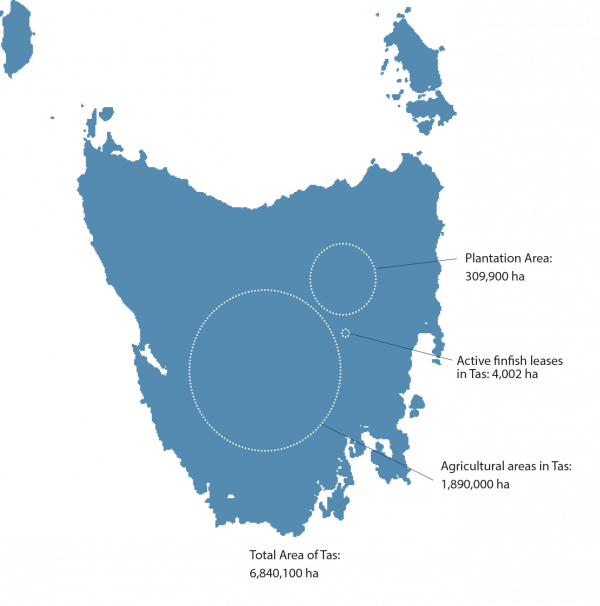
Tasmania’s salmon farming industry operates within a relatively small physical footprint. Active marine farming leases cover just over 4,000 hectares, compared with approximately 310,000 hectares of plantation forestry and nearly 1.9 million hectares used for agricultural production across the state.
Globally, increasing seafood consumption has the potential to support both human health and lower-emissions food production. Aquaculture, including salmon farming, plays an important role in meeting growing demand for sustainable protein sources while reducing pressure on wild fisheries.
Salmon farming is recognised as one of the most resource-efficient forms of animal protein production. It has a comparatively low carbon and water footprint, while also delivering high feed and protein conversion efficiency.
According to data from the Global Salmon Initiative, salmon has one of the lowest Feed Conversion Ratios (FCR) of all major farmed animal proteins. FCR measures how efficiently feed is converted into edible protein. On average, producing one kilogram of salmon requires approximately 1.2–1.5kilograms of feed, compared with significantly higher feed requirements for many land-based livestock industries.